

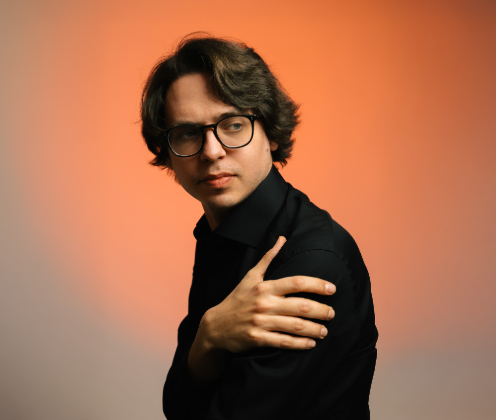
Friday, November 20th, at 8:30 PM at Sala 500
“Life is a lot like jazz: it’s best when you improvise.” These words by George Gershwin capture the philosophy of French pianist Lucas Debargue, for whom spontaneity and reinvention are key to bring new life into classical music, turning performance into an act of continuous and spontaneous reinvention. Debargue returns to Lingotto on Friday, November 20th, at 8.30 PM at Sala 500, to open the new Season of Pianisti del Lingotto series. The programme moves from the baroque wit of four Sonatas by Domenico Scarlatti to the refined sound world of Maurice Ravel, with his Sonatine M. 40 and Jeux d’eau M. 30, before reaching the dramatic intensity of Sergei Rachmaninoff’s Sonata No. 2 in B-flat minor, Op. 36. The evening closes with an original work based on a theme by George Gershwin: the Concert Variations and Finale in B major on Summertime, from Porgy and Bess. The piece reveals Debargue’s dual identity as both performer and composer, as well as his vision of music as a world without boundaries.
Lucas Debargue
Lucas Debargue discovered classical music at the age of ten, while also pursuing studies in literature and philosophy. Meeting Rena Shereshevskaya proved decisive, turning his passion for music into a full-fledged professional career. His turning point came in 2015, when he took fourth place at the 15th International Tchaikovsky Competition in Moscow. His artistic vision and creative freedom attracted widespread critical attention, earning him the award of the Moscow Music Critics Association. Since then, he has performed regularly at some of the world’s leading concert venues, working with renowned conductors and major orchestras across Europe and the United States. For Sony Classical, he has released a four-CD project devoted to Scarlatti, acclaimed by «The New York Times», as well as a complete recording of Gabriel Fauré’s piano works, awarded five Diapasons and the 2024 Choc by «Classica» magazine. A passionate advocate of lesser-known composers such as Karol Szymanowski, Nikolai Medtner and Miłosz Magin, Debargue also draws inspiration from literature, painting, cinema and jazz. On September 11th, 2026, he released Gershwin Variations, a double album dedicated to the music of George Gershwin.
A recital between tradition and reinvention
The concert opens with four Sonatas (K. 32, K. 214, K. 109, K. 45) by Scarlatti, works in which elegance, rhythmic drive and expressive freedom coexist in a strikingly modern balance. Single-movement pieces, these sonatas perfectly capture the spirit of the Neapolitan composer, who urged listeners not to look for profound meaning in them, but rather to enjoy a “witty exercise in art”. Like Scarlatti’s sonatas, Ravel’s Sonatine is shaped by a sense of brevity. While drawing explicitly on classical forms, it also explores new harmonic languages. Clarity and sensitivity to colour also define Jeux d’eau, widely regarded as one of the earliest examples of musical Impressionism for the piano. The lightness and refinement of Ravel’s music stand in contrast to the dramatic force of Rachmaninoff’s Sonata No. 2 in B-flat minor, Op. 36. The work unfolds in three uninterrupted movements, with virtuosic writing that pushes acoustic tension to its limits. The programme concludes with Gershwin’s Concert Variations and Finale in B major on Summertime, the famous theme that opens Porgy and Bess. In Debargue’s interpretation, the melody becomes the starting point for a musical journey in which jazz influences, classical tradition and shifting moods freely intertwine.