

Thursday, 29th October 2026, at 8:30 PM, at the Auditorium Agnelli
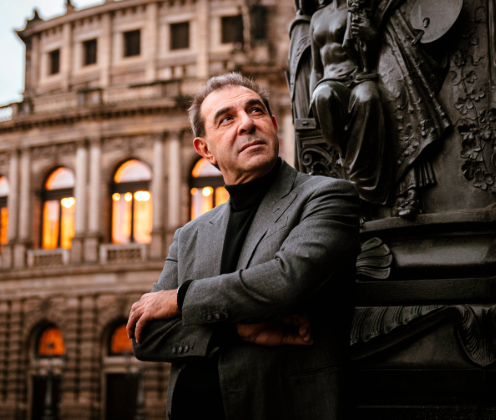
Almost five centuries of history distilled into a sound known simply as the «Dresdner Klang». Founded in 1548, the Sächsische Staatskapelle Dresden is one of the oldest orchestras in the world. Wagner described it as his «miracle harp», while Richard Strauss entrusted it with the premieres of nine of his operas. It is this distinguished ensemble that will open the 2026-2027 season of Concerti del Lingotto on Thursday, 29th October at 8:30 PM, at Turin’s Auditorium Giovanni Agnelli, under the baton of its principal conductor, Daniele Gatti. This will be his thirteenth appearance in the series of Concerti del Lingotto, confirming his position as its most frequent guest conductor, and his first time at the helm of the Dresden orchestra. The programme brings together excerpts from Parsifal by Richard Wagner and the Second Symphony by Johannes Brahms: repertoire that conductor and orchestra regard as an integral part of their artistic identity.
Lingotto Musica per la Comunità
With the opening of the new season, Lingotto Musica and Fondazione La Stampa – Specchio dei tempi, Charity Partner of the concert, reaffirm their commitment to solidarity through the Lingotto Musica per la Comunità programme. Together they promote the 50th edition of Tredicesime dell’Amicizia, the annual Christmas campaign that provides financial assistance to thousands of older people living alone and facing hardship.
Sächsische Staatskapelle Dresden
The Sächsische Staatskapelle Dresden returns to Turin thirteen years after its last appearance in the Lingotto series. Originally established as a court orchestra at the behest of Prince-Elector Maurice of Saxony, it has remained closely entwined with the history of Dresden ever since. Its distinguished musical lineage includes Heinrich Schütz, Johann Adolf Hasse and Carl Maria von Weber. Its podium has welcomed, among others, Ernst von Schuch, Fritz Busch, Karl Böhm, Rudolf Kempe, Bernard Haitink and, from 2012 to 2024, Christian Thielemann. The orchestra was resident at the Salzburg Easter Festival from 2013 to 2022, a role that earned it the Herbert von Karajan Prize. Each season, it performs around 250 opera and ballet performances at the Semperoper, alongside approximately fifty symphonic and chamber concerts.
Daniele Gatti
Daniele Gatti has led the orchestra since the 2024-2025 season. He first conducted the ensemble in February 2000, at the invitation of its then principal conductor, Giuseppe Sinopoli. Born in Milan in 1961, Gatti studied composition and conducting at the Giuseppe Verdi Conservatory. He made his debut at La Scala at the age of twenty-seven and has been the principal conductor of the Orchestre National de France, the Zurich Opera and the Royal Concertgebouw Orchestra, as well as music director of the Teatro dell’Opera di Roma. His association with Parsifal spans many years. In 2008, he conducted the opera at Bayreuth in Stefan Herheim’s production, which opened the Festival that year, and later at New York’s Metropolitan Opera in François Girard’s staging. With the Concertgebouw Orchestra, he also recorded the Prelude and the Karfreitagszauber. A three-time recipient of the Premio Abbiati as best conductor, he returned to Bayreuth in 2025 for a new production of Die Meistersinger von Nürnberg.
Three orchestral excerpts from Wagner’s Parsifal
In the summer of 1877, as Brahms was completing his Second Symphony on the shores of Lake Wörthersee, Richard Wagner began composing Parsifal in Bayreuth. Two works born in the same season, yet almost polar opposites, come together in this programme. The concert opens with three orchestral excerpts from Wagner’s «sacred festival drama», the work with which the composer took his leave of music theatre. First performed in Bayreuth in 1882 after five years in the making, Parsifal is imbued with a profound mystical dimension, one that Wagner himself explicitly emphasised. The Prelude to Act I introduces a world of solemn ritual, suspended between contemplation and foreboding, in which the Knights of the Grail guard the sacred cup that received the blood of Jesus the Redeemer. By contrast, the Prelude to Act III reveals a darker landscape of anticipation and disorientation, reflecting the protagonist’s long wanderings. The first half concludes with the Karfreitagszauber, or Good Friday Spell, in which nature blooms anew on the day of the Passion and, after so much darkness, the drama reaches its most serene and luminous moment.
Brahms’s Symphony No. 2 in D major, Op. 73
A very different atmosphere prevails in Johannes Brahms’s Symphony No. 2 in D major, Op. 73, premiered by the Vienna Philharmonic on 30th December 1877 under the baton of Hans Richter, shortly after the composer’s First Symphony. Written in a remarkably short time, the work seeks an intimate, almost chamber-like character that moves away from traditional symphonic conventions without entirely dispelling its darker shades. When the conductor Vincenz Lachner asked Brahms in 1879 why the Allegro non troppo contained such sombre passages for trombones and timpani, the composer defended them as the «necessary shadow» of a serene symphony, while describing himself as a «deeply melancholic man».