

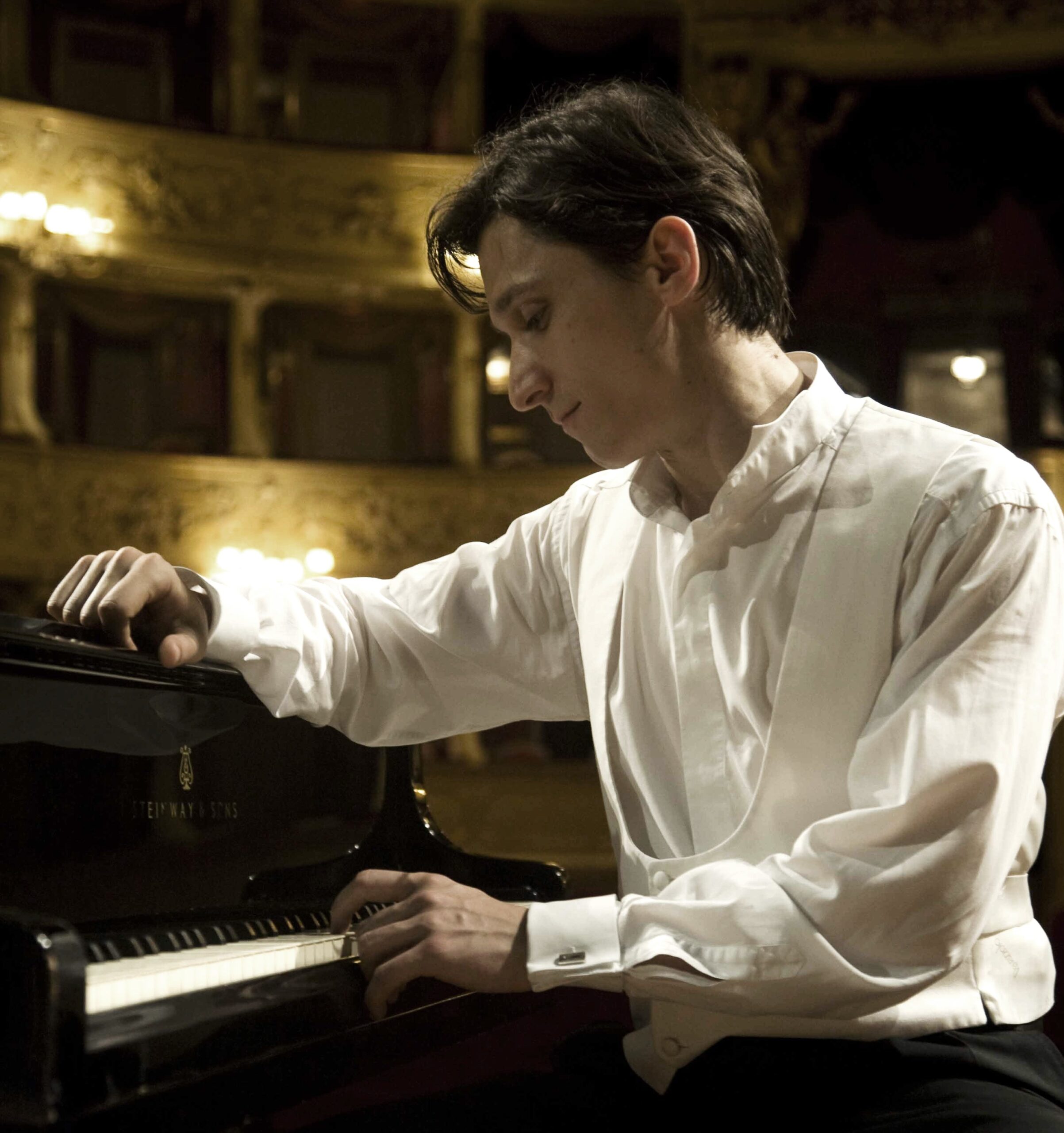
Tuesday, April 7th at 8:30 PM at Sala 500
Described by the New York Times as an extraordinary pianist, Alexander Romanovsky returns to Lingotto Musica after twelve years on Tuesday, April 7th at 8:30 PM at Sala 500, closing the 2025-2026 Pianisti del Lingotto series. The program opens with Mozart, featuring the Piano Sonata No. 10 in C major, K. 330 and Piano Sonata No. 8 in A minor, K. 310, followed by Debussy’s L’isle joyeuse and Mussorgsky’s Picture at an Exibition.
Alexander Romanovsky
Born in Ukraine in 1984, Alexander Romanovsky began studying the piano at the age of five, quickly revealing remarkable talent. At thirteen he moved to Italy to study at the Accademia Pianistica Internazionale di Imola with Leonid Margarius. In 2001 at seventeen he won First Prize at the Busoni Competition and in 2009 he completed his formal training by earning an Artist Diploma from the Royal College of Music in London. Since then, he has been a regular guest at the world’s most prestigious venues, performing with leading orchestras and collaborating with renowned conductors. His critically acclaimed recordings for Warner Classics and Decca include the complete piano concertos of Glazunov and Rachmaninov. Romanovsky is actively engaged in teaching at the Conservatorio di Pavia and the Accademia di Musica di Pinerolo.
The program highlights his interpretive qualities, opening with Mozart to showcase two contrasting yet complementary facets of the composer’s artistic sensibility. The Piano Sonata No. 10 in C major, K. 330 (1783) unfolds in a balanced musical writing, where lyricism and formal clarity emerge seamlessly. In contrast, the Sonata No. 8 in A minor, K. 310 (1778) represents one of Mozart’s rare forays into this key. Written in Paris during a period marked by conflict with his father and the death of his mother, it carries a quite unusual restlessness and a dramatic intensity. Composed by Debussy in 1904, L’isle joyeuse was inspired by a painting by Antoine Watteau: the composer creates an imaginary landscape of movement and colors. Also translating visual art into sound, Mussorgsky’s Pictures at an Exhibition originated from a 1874 visit to an exhibition in St. Petersburg dedicated to the painter Viktor Hartmann. Moving among the works, Mussorgsky was so moved that he decided to translate them into music. The result was a piano suite that musically describes a selection of those drawings, linked by the recurring Promenade theme, which represents the visitor moving between the galleries. The composer evokes scenes, architectures and characters from the Slavic tradition and beyond. Ravel’s 1922 orchestration reveals just how much orchestral colorism was already implicitly present in the original piano version.