

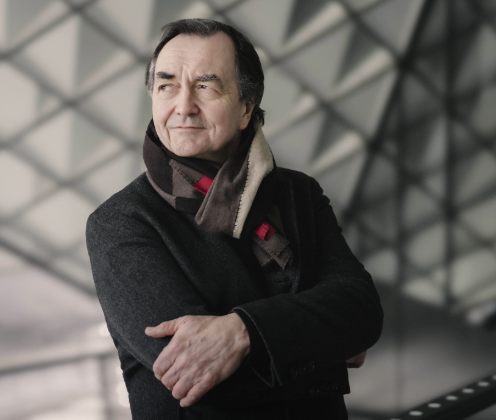
Pierre-Laurent Aimard and the CAMERATA Salzburg, led by concertmaster Giovanni Guzzo, comes—on Tuesday 27 January at 8:30 p.m. at the Auditorium Giovanni Agnelli—with a programme devoted entirely to Viennese Classicism. The eclectic French pianist makes his debut at Lingotto Musica with two Mozart piano concertos — the No. 27 in B-flat major, K. 595, and the No. 17 in G major, K. 453. The dramatic Overture from L’anima del filosofo by Franz Joseph Haydn opens the evening, preparing the expressive ground for the Mozartian journey, while a selection of orchestral Minuets, K. 599, completes the programme, offering a moment of elegant lightness.
Studing with Yvonne Loriod and working with Pierre Boulez, Pierre-Laurent Aimard has forged a unique career, embracing both classical and contemporary repertoire. A reference pianist of our time, he has developed close relationships with Messiaen, Kurtág, Ligeti, Carter, Lachenmann, Stockhausen and Benjamin. Over his wide-ranging career he has collaborated with the world’s leading orchestras and performed in the most prestigious concert halls. His interpretations—honoured with Grammy and Gramophone Awards—are distinguished by an analytical approach and programmes conceived as coherent musical journeys. His extensive discography ranges from Bach to contemporary composers. Since 2007, Pierre-Laurent Aimard has been an exclusive Deutsche Grammophon artist.
One of the world’s most prestigious chamber orchestras, the CAMERATA Salzburg performs regularly in the major concert halls as well as at the Mozarteum in Salzburg, where it presents its own concert season. Founded by Bernhard Paumgartner in 1952, it is one of the reference ensembles of the Salzburg Festival. Over more than seventy years of activity, it has collaborated with artists such as Alfred Brendel, Philippe Herreweghe, Sir John Eliot Gardiner, Manfred Honeck, Anne-Sophie Mutter, Teodor Currentzis, Fazıl Say, Renaud Capuçon, Yuja Wang and Hélène Grimaud. The orchestra has also recorded more than sixty albums for Deutsche Grammophon, Decca, Sony and Warner Classics.
The evening opens with the Overture from L’anima del filosofo by Franz Joseph Haydn, a dramatic page linked to the composer’s final theatrical work. Left unfinished and never performed during his lifetime, it represents a curious reworking of the myth of Orpheus and Eurydice. The heart of the programme is entirely devoted to Wolfgang Amadeus Mozart, with two piano concertos belonging to the highest and most self-aware phase of his career. The Piano Concerto No. 27 in B-flat major, K. 595, is the last work of its kind composed by Mozart, marked by introspection and reflection. Its music looks beyond the brilliance of the eighteenth-century concerto, anticipating a lyrical and introspective dimension that would fully unfold in Romanticism. The Minuets, K. 599, return to a lighter, more convivial dimension. The Piano Concerto No. 17 in G major, K. 453, brings the journey to a close: the piano never dominates on the orchestra, engaging it in a continuous interplay of thematic echoes and transformations in which every instrument of the orchestra seems to take an active part in shaping the musical narrative.